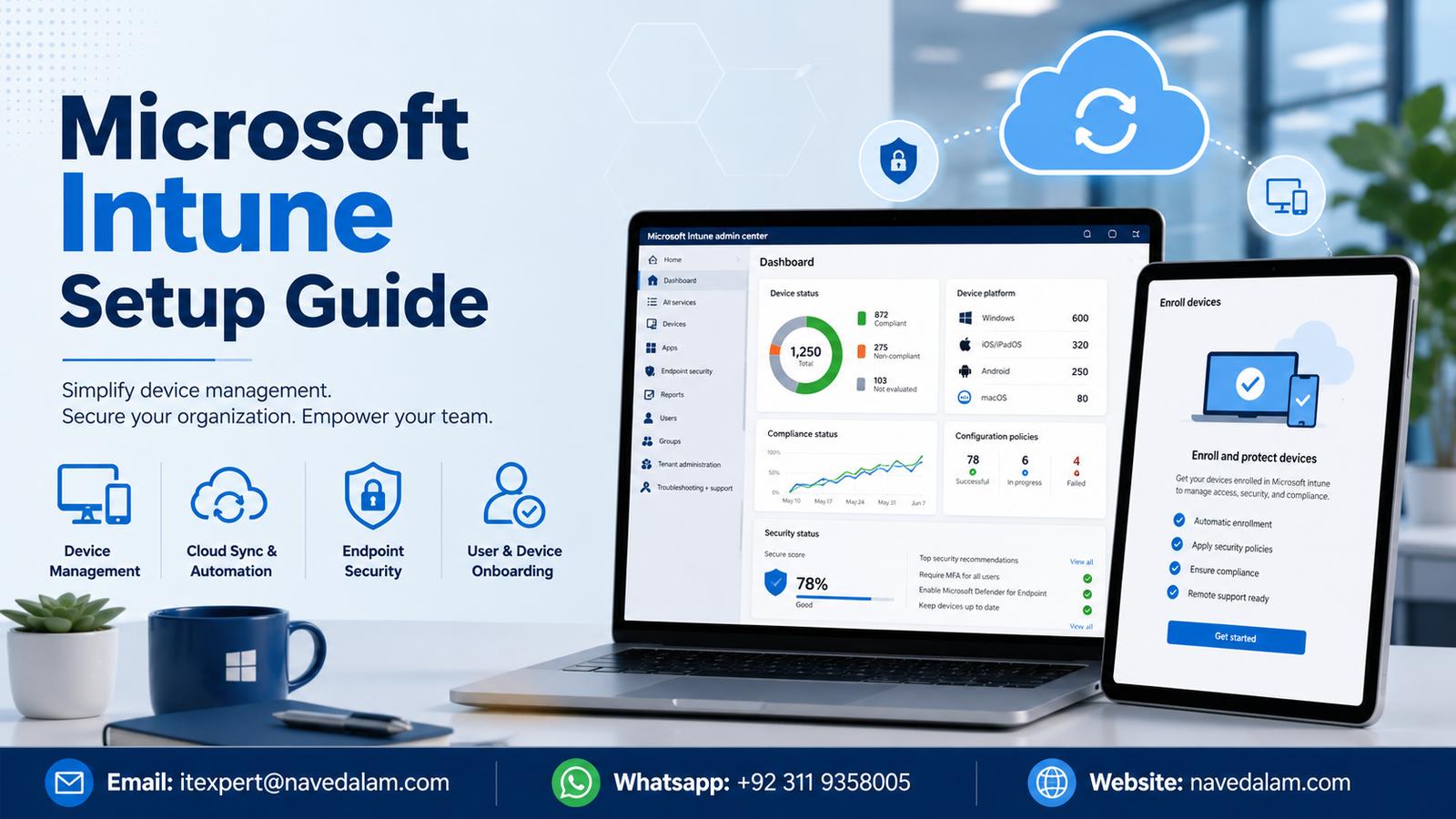

This microsoft intune setup guide is written for IT administrators who need to move fast without making expensive configuration mistakes.
Microsoft Intune is Microsoft’s cloud-based Mobile Device Management (MDM) and Mobile Application Management (MAM) platform — part of the Microsoft Endpoint Manager suite. It lets you manage and secure every device in your organisation from a single web console, regardless of whether those devices are company-owned or personal (BYOD).
Following this microsoft intune setup guide correctly from the start means your organisation avoids the two most common and costly mistakes: enrolling devices before compliance policies exist, and enabling conditional access before testing it on a pilot group.
This microsoft intune setup guide covers every step: licensing, tenant configuration, device enrollment for Windows 10/11, iOS, and Android, compliance policy setup, conditional access, app protection policies, and the operational best practices that keep your deployment running cleanly long-term.
Table of Contents
- Why Microsoft Intune Is the Right MDM Choice in 2026
- Microsoft Intune Pricing Plans 2026
- Intune vs SCCM: Which Should You Use?
- Prerequisites and Tenant Setup
- Device Enrollment Step by Step
- Intune Compliance Policy Setup
- Conditional Access Configuration
- App Protection Policy Configuration
- Real-World Deployment Example
- Troubleshooting Common Intune Issues
- Microsoft Intune Best Practices
- Frequently Asked Questions
- Conclusion
Why This Microsoft Intune Setup Guide Matters in 2026
The endpoint management landscape has shifted dramatically. Remote and hybrid work means corporate data now lives on personal phones, home laptops, and unmanaged tablets — and traditional on-premises tools like SCCM were never designed for this reality.
Microsoft Intune solves this with a 100% cloud-native approach. There is no infrastructure to deploy, no on-premises server to maintain, and no VPN required for policy delivery.
Every policy, every compliance check, and every app deployment reaches devices wherever they are — over the internet.
For businesses already running Microsoft 365, this microsoft intune setup guide delivers immediate value: Intune is included in Microsoft 365 Business Premium, E3, and E5 plans at no additional cost. According to Microsoft’s official Intune documentation, the platform manages over 60 million endpoints worldwide — making it the largest cloud MDM platform by deployment count.
Key business drivers for following this microsoft intune setup guide:
- Enforce device compliance before granting access to company data
- Wipe corporate data from lost or stolen devices without touching personal data
- Deploy applications silently to hundreds of devices without user interaction
- Meet compliance requirements (ISO 27001, SOC 2, GDPR) through audit-ready policy enforcement
- Eliminate the need for on-premises MDM infrastructure and the costs that come with it
Microsoft Intune Pricing Plans 2026
Understanding licensing is the first step in this microsoft intune setup guide — choosing the wrong plan either leaves features locked or wastes budget on capabilities you will never use.
| Plan | Intune Included | Key Features | Best For |
|---|---|---|---|
| Microsoft 365 Business Premium | Yes | MDM, MAM, Conditional Access | SMBs up to 300 users |
| Microsoft 365 E3 | Yes | MDM, MAM, Advanced Compliance | Enterprise, 300+ users |
| Microsoft 365 E5 | Yes | Full suite + Defender for Endpoint | Enterprise with advanced security |
| Intune Plan 1 (standalone) | Yes | Core MDM and MAM | Orgs without M365 suite |
| Intune Plan 2 (add-on) | ~$4.50/user/month | Tunnel, Endpoint Privilege Management | Advanced enterprise scenarios |
For most small businesses following this microsoft intune setup guide, Microsoft 365 Business Premium is the correct starting point. It includes Intune, Azure AD P1 (required for conditional access), Defender for Business, and the full Office suite in one licence.
Intune vs SCCM: Which Should You Use?
This question comes up in every enterprise MDM evaluation. The short answer from this microsoft intune setup guide: most organisations should use Intune, with co-management as a transition path if they have an existing SCCM investment.
| Factor | Microsoft Intune | SCCM (ConfigMgr) |
|---|---|---|
| Architecture | 100% cloud — no on-premises infrastructure | On-premises servers required |
| Mobile Devices | Full iOS, Android, Windows, macOS | Limited mobile support |
| Remote Workers | Manages devices anywhere, no VPN needed | Requires VPN or CMG for remote devices |
| Cost | Included in M365 Business Premium / E3 | Separate licence + server infrastructure costs |
| Complexity | Low — web console, no server management | High — requires dedicated infrastructure team |
| Best For | Cloud-first, hybrid, BYOD, SMB to enterprise | Large enterprises with complex on-premises deployment |
Prerequisites and Tenant Setup
Before enrolling a single device using this microsoft intune setup guide, complete these tenant-level configuration steps.
Skipping them creates enrollment failures that are frustrating to diagnose after the fact.
Step 1: Set the MDM Authority
Your MDM authority tells Microsoft 365 which management platform owns device enrollment. If you have never used SCCM, this is set to Intune by default. Verify it before proceeding.
Go to the Microsoft Intune admin center at intune.microsoft.com, navigate to Tenant administration → Tenant status, and confirm the MDM authority shows “Microsoft Intune”.
Step 2: Configure Automatic Enrollment
Automatic enrollment allows Windows 10/11 devices joined to Azure AD to enroll in Intune without user interaction. This is the foundation of a scalable deployment.
Navigate to: Azure portal → Azure Active Directory → Mobility (MDM and MAM) → Microsoft Intune → set MDM User Scope to “All” or a pilot group first.
Step 3: Configure Company Branding
Users see the Company Portal during enrollment. Branded portals reduce helpdesk calls because users recognise the interface as coming from their employer rather than an unknown source.
Navigate to: Intune admin center → Tenant administration → Customization → add your company name, logo, and support contact details.
Device Enrollment Step by Step
Device enrollment is the core of this microsoft intune setup guide. The enrollment method you choose determines the management capabilities available to you.
Windows 10/11 Enrollment — Azure AD Join
Azure AD Join with automatic Intune enrollment is the correct approach for all new Windows 10/11 devices in a cloud-first organisation.
On the device: Settings → Accounts → Access work or school → Connect → sign in with the user’s Microsoft 365 account. The device automatically joins Azure AD and enrolls in Intune.
For bulk enrollment using Windows Autopilot — the most scalable approach for enterprise deployments in this microsoft intune setup guide:
- Collect device hardware IDs from your vendor or using the Get-WindowsAutopilotInfo script
- Upload the CSV to Intune admin center → Devices → Windows → Windows enrollment → Devices
- Create an Autopilot deployment profile assigning the device experience and enrollment behaviour
- When the device powers on and connects to the internet, it automatically enrolls without IT touching it
iOS/iPadOS Enrollment
For company-owned iOS devices, Apple Business Manager (ABM) integrated with Intune via Apple DEP provides zero-touch enrollment — the same model as Windows Autopilot.
For personal iOS devices (BYOD), users download the Company Portal app from the App Store and enroll through the app. This enrolls the device for MAM policies without giving IT full device management.
Android Enrollment
Intune supports four Android enrollment modes. For this microsoft intune setup guide, the two most commonly used are:
- Android Enterprise — Fully Managed: Corporate-owned devices where IT controls the entire device
- Android Enterprise — Work Profile: BYOD devices where a separate encrypted work profile keeps corporate apps isolated from personal data
Verify Enrollment
After enrollment, verify the device in the Intune admin center: Devices → All devices → confirm the device shows Compliance Status and Last Check-in timestamp.
Intune Compliance Policy Setup
Compliance policies are the rules that determine whether a device is allowed to access company resources. This is the most important security configuration in this entire microsoft intune setup guide.
Always create compliance policies before enabling conditional access. Enabling conditional access without compliance policies blocks all devices immediately.
Create a Windows Compliance Policy
Navigate to Intune admin center → Devices → Compliance policies → Create policy → Windows 10 and later.
Recommended compliance settings for business environments following this microsoft intune setup guide:
| Setting | Recommended Value | Why It Matters |
|---|---|---|
| BitLocker | Require | Encrypts disk — protects data on lost or stolen devices |
| Secure Boot | Require | Prevents boot-level malware |
| Minimum OS Version | 10.0.19044 or higher | Blocks outdated, unpatched Windows versions |
| Password Required | Yes | Prevents unattended device access |
| Antivirus | Require | Ensures Defender or third-party AV is running |
| Firewall | Require | Blocks unsolicited inbound connections |
Assign the policy to an Azure AD group. Set the noncompliance action to “Send email to end user” with a 3-day grace period — this avoids locking users out immediately while giving them time to remediate.
Conditional Access Configuration
Conditional access is the enforcement engine that makes compliance policies meaningful. Without it, a noncompliant device still accesses Exchange, SharePoint, and Teams — compliance policies alone have no enforcement power.
Conditional access requires Azure AD P1 licensing, included in Microsoft 365 Business Premium and E3.
Create a Baseline Conditional Access Policy
Navigate to Azure portal → Azure Active Directory → Security → Conditional Access → New policy.
Recommended baseline settings for this microsoft intune setup guide:
- Users: All users (exclude break-glass emergency admin accounts)
- Cloud apps: Office 365 (covers Exchange, SharePoint, Teams)
- Conditions → Device platforms: Windows, iOS, Android
- Grant: Require device to be marked as compliant
- Enable policy: Report-only first — switch to On after 7-day pilot validation
Critical: Always start conditional access in Report-only mode. Switching directly to On without a pilot phase locks out noncompliant devices immediately — including devices that have not yet checked in and received their compliance status.
App Protection Policy Configuration
App protection policies (APP) control how corporate data is handled within managed apps — even on unmanaged BYOD devices. This is the MAM layer of this microsoft intune setup guide.
Navigate to Intune admin center → Apps → App protection policies → Create policy → iOS/iPadOS.
Key settings for a production app protection policy:
- Prevent backups: Block — stops corporate data being backed up to iCloud
- Send org data to other apps: Policy managed apps only — prevents copy-paste to personal apps
- Receive data from other apps: Policy managed apps only
- Minimum PIN length: 6 digits
- Offline grace period: 720 hours — after this, the app requires re-authentication
- Wipe data after failed PIN attempts: 10 attempts
Assign to all users or a specific security group. Target the core productivity apps: Microsoft Outlook, Teams, OneDrive, and Edge.
Real-World Microsoft Intune Setup Guide Deployment Example
Case Study: Professional Services Firm — 120 Users, 3 Countries
A professional services firm with 120 employees across Pakistan, UAE, and UK engaged us to implement a complete Microsoft Intune MDM solution following this microsoft intune setup guide framework.
Challenge: Employees were using personal laptops and phones to access Exchange Online and SharePoint with no device management in place. A lost laptop incident had already exposed client documents — compliance auditors flagged it as a critical gap.
What we implemented: Microsoft 365 Business Premium licences for all 120 users provided Intune at no additional cost.
Windows Autopilot handled enrollment for 80 company laptops — IT never touched a device. App protection policies covered the 40 BYOD mobile users without enrolling their personal devices.
Conditional access was staged over three weeks: Report-only for week 1, pilot group (IT team) for week 2, all users for week 3.
Results: 100% of company-owned devices enrolled within 10 days. Zero helpdesk calls during the conditional access rollout. The client passed their next ISO 27001 audit with Intune compliance reports as evidence. Total additional IT cost: zero — Intune was already included in their M365 licences.
Lesson learned: The 3-week staging approach for conditional access was the critical success factor. A previous internal attempt had flipped conditional access to On immediately — it locked out 30 users in the first hour.
Troubleshooting Common Microsoft Intune Issues
Issue 1: Device Shows “Not Compliant” After Enrollment
Symptoms: Device enrolled successfully but compliance status shows “Not compliant” or “Not evaluated”.
Root cause: Compliance policy not yet assigned to the user or device group, or the device has not yet checked in to receive the policy. Check-in happens within 8 hours of enrollment, or on demand.
Force an immediate policy sync: on Windows, open Settings → Accounts → Access work or school → click the account → Info → Sync. On iOS or Android, open Company Portal → Check compliance.
Prevention: Assign compliance policies to groups before enrolling devices. Use the “All Devices” or “All Users” group to ensure coverage.
Issue 2: Windows Autopilot Enrollment Fails
Symptoms: Device goes through OOBE, reaches Autopilot setup, then fails with a generic error.
Root cause: Device hardware hash not uploaded, incorrect Autopilot profile assignment, or corporate proxy blocking Autopilot endpoints.
Check the Autopilot deployment status: Intune admin center → Devices → Monitor → Autopilot deployments. The status shows exactly which step failed. Ensure the device has internet access to Microsoft endpoints (*.microsoftonline.com, *.manage.microsoft.com) before starting OOBE.
Issue 3: Conditional Access Blocking All Users
Symptoms: After enabling conditional access, users cannot access Office 365 from any device.
Root cause: Policy set to On before devices received compliance status, or MDM authority not set correctly.
Immediately switch the conditional access policy back to Report-only in the Azure portal. Check that the MDM authority is set to Intune. Allow 24 hours for devices to check in and receive compliance status before re-enabling.
Microsoft Intune Setup Guide Best Practices
- Stage every policy change through a pilot group first. Test on IT staff before rolling out to all users. This single practice prevents every major Intune outage we have been called to recover.
- Use Azure AD dynamic groups for automatic policy targeting. Dynamic groups based on device attributes ensure new devices automatically receive the correct policies without manual assignment.
- Enable the Intune Data Warehouse for compliance reporting. Built-in reports satisfy most audit requirements — export compliance data directly to prove device posture to auditors.
- Configure Windows Update rings to manage patching. Create three rings: Pilot (IT team, immediate), Early Adopter (10% of users, 1-week delay), Broad (all users, 2-week delay).
- Enable Microsoft Defender for Endpoint integration. Connecting Defender to Intune gives you device risk signals in conditional access — blocking devices with active threats even if they pass configuration compliance checks.
- Never use “All Devices” as your conditional access target on day one. Always start with a scoped pilot group. The cost of testing is one week. The cost of getting it wrong is locking out your entire organisation.
Frequently Asked Questions
How do I set up Microsoft Intune step by step?
To complete a full microsoft intune setup guide: verify your Microsoft 365 licence includes Intune, set the MDM authority to Intune in the admin center, configure automatic enrollment in Azure AD, create compliance policies, enroll devices via Azure AD Join or Autopilot, then enable conditional access in Report-only mode before going live. The process takes 2–5 business days for a 100-user organisation with proper staging.
Is Microsoft Intune free with Microsoft 365?
Yes — Microsoft Intune is included at no additional cost in Microsoft 365 Business Premium, E3, and E5 plans. Standalone Intune Plan 1 is available for approximately $8 per user per month for organisations without the full Microsoft 365 suite. Intune Plan 2, which adds Microsoft Tunnel and Endpoint Privilege Management, is an add-on at approximately $4.50 per user per month.
What is the difference between Intune and SCCM?
Intune is a 100% cloud-based MDM platform requiring no on-premises infrastructure — it manages devices over the internet from anywhere. SCCM (Configuration Manager) is an on-premises platform designed for devices connected to the corporate network, with limited mobile device support. For organisations with remote workers or a cloud-first strategy, the answer is clear from this microsoft intune setup guide: Intune is the correct choice. Large enterprises with complex on-premises software deployment requirements often use both together via co-management.
How do I enroll devices in Microsoft Intune?
Windows 10/11 devices enroll by joining Azure AD with a Microsoft 365 account — automatic enrollment handles the Intune registration. iOS devices use the Company Portal app or Apple DEP for corporate-owned devices. Android devices use the Company Portal app for BYOD work profile enrollment or Android Zero Touch for corporate-owned devices. Windows Autopilot enables zero-touch bulk enrollment for new Windows devices.
What are the system requirements for Microsoft Intune?
Intune has no on-premises hardware requirements — it is fully cloud-based. Managed devices require Windows 10/11 (any edition), iOS 16 or later, Android 8.0 or later, or macOS 12 or later. Users need a Microsoft Intune licence assigned in Azure AD. A supported browser is required to access the Intune admin center.
Conclusion: Your Microsoft Intune Setup Guide Summary
Completing this microsoft intune setup guide gives your organisation a production-grade MDM and MAM deployment that secures every device — company-owned and personal — without on-premises infrastructure.
The staged approach in this microsoft intune setup guide — compliance policies first, conditional access in report-only, then live rollout — is the single most important operational discipline that separates successful Intune deployments from failed ones.
Key takeaways from this microsoft intune setup guide:
- License correctly first: Microsoft 365 Business Premium includes everything most SMBs need at no extra Intune cost
- Compliance before conditional access: Policies without enforcement are informational. Enforcement without policies is a lockout waiting to happen
- Stage every change: Pilot group → early adopter → all users. Every time
- App protection covers BYOD without full enrollment: MAM policies protect corporate data on personal devices without requiring MDM enrollment
- Intune plus Defender is the complete endpoint security stack: Integrating both gives conditional access based on real-time device threat intelligence
Related reading on navedalam.com:
- Azure VPN Gateway Configuration — secure hybrid connectivity complementing your Intune-managed endpoints
- Hyper-V Setup Guide — on-premises VM infrastructure for your Intune-managed environment
- Azure Cost Optimization Guide — reduce cloud spend while running your Intune-managed Azure infrastructure
- Remote IT Support Services — expert Intune deployment and troubleshooting support
External references:
- Microsoft Intune — Official Documentation
- Windows Enrollment Methods in Intune — Microsoft Learn
- NIST SP 800-124: Guidelines for Mobile Device Security
Need Expert Help with Microsoft Intune Deployment?
I provide professional Intune deployment and MDM consulting services for businesses across Pakistan and internationally.
Whether you need a full Intune environment configured from scratch, a migration from an existing MDM platform, or help recovering a broken conditional access deployment — I can help remotely, fast.
Services Offered
- Microsoft Intune MDM and MAM deployment
- Conditional access design and staged rollout
- Windows Autopilot configuration
- Microsoft 365 security and compliance
- Azure AD and identity management
- Endpoint security with Defender for Endpoint integration
Email: itexpert@navedalam.com
WhatsApp: +92 311 935 8005
Website: navedalam.com
Free 30-minute consultation — no obligation.
About the Author
Naveed Alam is a certified Network and Cloud Engineer specialising in Microsoft 365, Azure, endpoint management, and enterprise IT infrastructure. With 50+ completed projects across Pakistan and internationally, Naveed helps organisations deploy and secure their IT environments.
Certifications: Cisco CCNA · Microsoft Azure Fundamentals (AZ-900) · CompTIA A+ · Fortinet NSE 4
LinkedIn · navedalam.com · itexpert@navedalam.com